
· by Michael Blair, Nashville's Masonry
Sealing brick gets recommended as routine protection, and it is one of the few maintenance decisions that can actively destroy the thing it is meant to protect. Whether it helps depends on the product and on understanding that a brick wall is designed to get wet and then dry out again.
How a brick wall is supposed to work
Brick and mortar are porous by design. A masonry wall absorbs water in rain and releases it as vapor afterwards, and the assembly behind it, whether a cavity in a veneer wall or the mass of an older solid wall, is built around that cycle.
Water also arrives from inside. Household moisture moves outward through the wall in winter, and in a Middle Tennessee summer the vapor drive reverses. Either way the brick has to be able to pass vapor, and anything that blocks it changes how the whole assembly behaves.
What a film sealer does to it
A film-forming sealer, which includes most of the glossy waterproofing coatings and any elastomeric paint, puts a vapor barrier on the outside face. Water still gets into the wall, at the mortar joints, at the top, around windows and from behind, and now it cannot leave.
Trapped water freezes. Middle Tennessee cycles above and below freezing many times each winter, and each cycle expands water sitting just under the sealed face. That is what pops the face off a brick, and spalling of that kind cannot be repaired, only replaced.
- Film and elastomeric coatings trap vapor in the wall
- Trapped water plus freeze-thaw cycles causes spalling
- Spalled brick faces cannot be repaired, only replaced
- Breathable siloxane repellents are the appropriate product
- No sealer fixes water entering through failed mortar or flashing
The product that is appropriate
A breathable penetrating water repellent, usually silane or siloxane based, soaks in and reduces liquid water absorption while still allowing vapor to pass. It leaves the appearance unchanged and it does not peel, because there is no film to peel.
Even that is not a default. It is worth considering on a wall with genuine wind-driven rain exposure, on soft historic brick after appropriate assessment, or where absorption is measurably causing a problem. On a sound wall that is drying normally it is money spent on a wall that did not need it.
What to fix instead
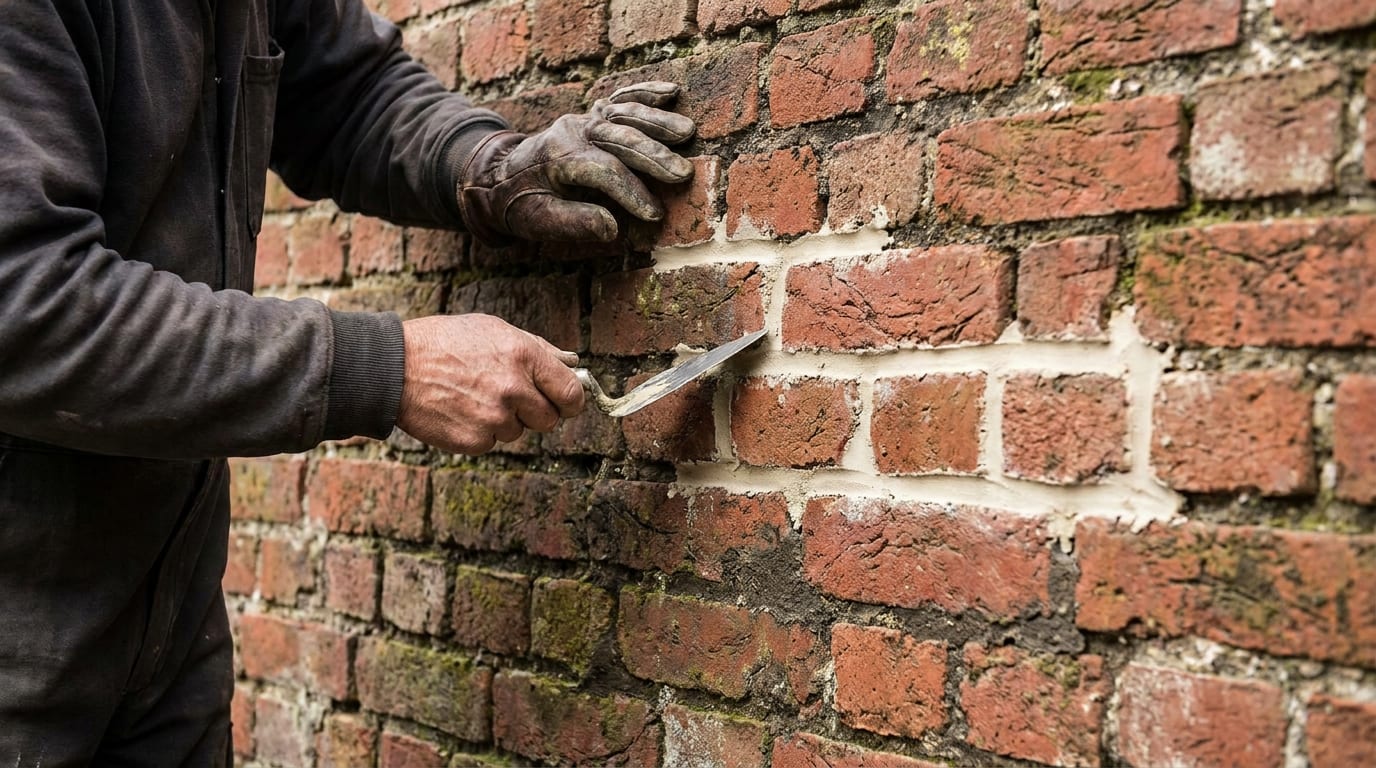
Almost all water problems in a brick wall are entry points rather than absorption through the face. Failed mortar joints are the first, which is a repointing job with mortar matched to the original in strength rather than a sealing job. Modern hard mortar on old soft brick causes its own spalling.
Then the details: cap flashing at the top of a wall, flashing and weep holes at the base of a veneer, sealant at window and door perimeters, and gutters that are not sending water down the face. Water is nearly always getting in somewhere specific, and finding it beats coating everything.