
· by Michael Blair, Nashville's Masonry
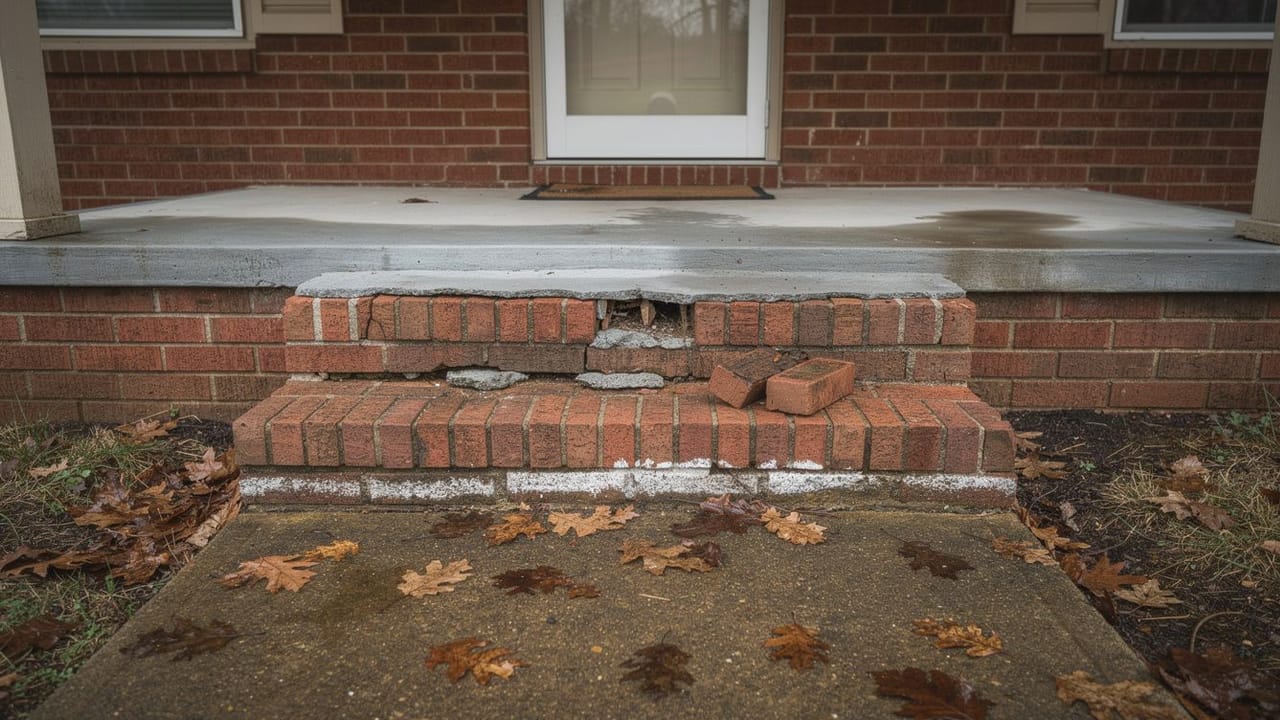
A set of brick front steps takes more weather than almost any other masonry on a house. It sits low, where ground moisture reaches it, it catches whatever runs off the porch above, and in winter it is where the salt goes. When bricks on the treads rock underfoot or the mortar between them comes out in pieces, resetting the loose ones is the easy part. Whether the repair lasts depends on what kept the step wet and whether the step itself is still moving. Here is what we look at when a call about brick repair in Nashville turns out to be the front steps.
Why are the bricks on my front steps coming loose?
Bricks on front steps come loose mostly because water gets into them and then freezes. General Shale’s homeowner bulletin, Caring for Your Brick Home, from the brick maker based in Johnson City, calls out porch walls in particular: they take on moisture from the ground below and from rain running off the porch cap above. When a soaked brick freezes again and again, its face can let go in a thin layer, which the bulletin puts at about an eighth to a quarter of an inch, and the mortar joints crack open the same way.
Middle Tennessee winters give that process plenty of turns. NOAA’s 1991–2020 climate normals for Nashville International Airport count about 66 days a year with a low at or below 32°F, spread from October to April, and only around six that stay below freezing all day. A wet step thaws in the afternoon and freezes again that night, many times a season. Every opened joint lets in more water the next time, and the tread bricks, which also take the foot traffic, are the first to rock. What happens to the faces is in our post on brick spalling.
Does rock salt damage brick steps?
Rock salt does damage brick steps, and the harm adds up over several winters. The General Shale bulletin warns that rock salt and other de-icing chemicals will in time break down every kind of masonry and concrete. One reason it gives is that salt lowers the temperature at which ice melts, so a salted step can go through more freeze and thaw cycles than an unsalted one. It also says soluble salts speed up the spalling described above, and it advises against piling snow against a brick wall, where it melts into the lowest courses for days.
On a set of brick steps that means keeping de-icer off the brick where you can, clearing the slush rather than leaving it to sit in the joints, and not heaping the snow from the walk against the sides of the steps. None of that reverses damage already done. It does slow the next round once the step has been repaired.
Can you repair brick steps with mortar?
Brick steps can be repaired with mortar when the step underneath is not moving: the loose bricks come up, the old mortar is cleaned off, and they go back down in fresh mortar matched to what is there, as described in our post on how repointing should be done. Mortar alone will not hold, though, if the water that loosened them is still getting in.
The General Shale bulletin’s maintenance list covers most of that water. It calls for sealant at every joint where brick meets concrete, including along the underside of a porch cap where it rests on the brick below, and in the control joints of the cap itself. It notes that the International Residential Code asks for six inches of fall away from the house within the first ten feet, and it says lawn sprinklers should not wet masonry. A step that has dropped, tilted or opened a gap against the house is a different job. The base has to be dealt with before any brick is reset, which is the work on our stone walls and steps page.
- Sealant where brick meets the concrete porch cap, including underneath it
- Sealant in the control joints of the cap
- Ground that falls away from the steps and the house
- Sprinkler heads turned so they do not spray the brick
How tall can the risers on brick steps be?
Under the 2018 International Residential Code, a riser on residential steps can be no taller than 7 3/4 inches, and within one flight the tallest riser may exceed the shortest by no more than 3/8 inch. Those figures, and a 10-inch minimum tread depth, are in Knox County’s handout on 2018 IRC residential stairs. The same handout gives handrails at 34 to 38 inches on a flight of four or more risers, and guards at least 36 inches high on a porch more than 30 inches above grade.
A rebuild is the moment those numbers apply, because a step relaid on a new base can be brought back to even risers. For the footing, the Tennessee edition of the 2018 IRC puts exterior footings at least 12 inches below undisturbed ground and below the local frost line. Knox County’s handout carries its own amendments, so we confirm the dimensions and the frost depth with Metro Codes or the codes office for your city before a rebuild starts. If your steps are loose, rocking or sinking, tell us what you are seeing and we will look at the step and its base before we quote.
Sources
- General Shale Brick, Tech Bulletin: Caring for Your Brick Home (November 15, 2021) — Porch walls take water from the ground and from the cap; sealant at brick-to-concrete joints, under the cap and in cap control joints; rock salt and de-icers; more freeze and thaw cycles; snow against walls; spalling 1/8 to 1/4 inch; six inches of fall in ten feet; sprinklers off masonry
- NOAA National Centers for Environmental Information, 1991–2020 Monthly Climate Normals, Nashville International Airport — About 66 days a year with a low at or below 32°F (October to April) and about 6 with a high at or below 32°F
- Knox County Code Administration and Inspection, 2018 IRC Residential Stairs Information — 2018 IRC riser height (7 3/4 inch maximum, 3/8 inch variation), 10 inch minimum tread, handrails 34 to 38 inches, guards 36 inches above 30 inches; a county handout that includes its own amendments
- UpCodes, Tennessee 2018 International Residential Code, Chapter 4: Foundations — R403.1.4 exterior footings at least 12 inches below undisturbed ground; R403.1.4.1 frost protection below the frost line
FAQ
Brick Front Steps Coming Loose: Why and the Fix — questions
How do you repair brick steps?
Stop the water first: seal the joints where brick meets the concrete cap, make the ground fall away from the steps and keep sprinklers off the brick. Then lift the loose bricks, clean off the old mortar and relay them in fresh mortar matched to the existing joints. A sinking step needs its base addressed first.
Do brick steps need a footing?
A rebuilt set of steps sits on a base, and the Tennessee edition of the 2018 IRC places exterior footings at least 12 inches below undisturbed ground and below the local frost line. We confirm the frost depth with Metro Codes or the city’s codes office. A step that has dropped or tilted is moving, and its base comes first.
Can you put rock salt on brick steps?
It is better not to. General Shale’s homeowner bulletin says rock salt and other de-icers break down masonry and concrete over time, partly because salt lowers the melting point of ice and adds freeze and thaw cycles. Keep de-icer off the brick where you can, clear the slush and do not pile snow against the steps.
What is the maximum riser height for porch steps?
Under the 2018 International Residential Code, as Knox County’s stairs handout sets it out, a riser can be no taller than 7 3/4 inches, the tallest and shortest risers in one flight can differ by no more than 3/8 inch, and treads must be at least 10 inches deep. Confirm with your local codes office before a rebuild.
Why do brick steps keep coming loose after a repair?
Usually because the water that loosened them was never stopped. Porch walls take water from the ground and from the cap above, and Nashville averages about 66 freezing nights a year. Without sealant where brick meets concrete, grading that falls away and sprinklers kept off the brick, freshly reset bricks go through the same cycle again.