
· by Michael Blair, Nashville's Masonry
People who search for a brick mason in Nashville and people who search for a stone mason are usually after the same thing: someone to fix a wall, a set of steps or a chimney. The two titles name two different occupations in the federal government’s own job classification, and the difference matters on a house that has both materials, as plenty of houses around Nashville do. Here is what each trade does by the Labor Department’s description, how we decide who works on what in our stone and brick work, and where the region’s best-known building stone fits.
Is a brick mason the same as a stone mason?
No, they are two occupations with two separate entries in O*NET, the occupational database sponsored by the U.S. Department of Labor. O*NET’s profile of brickmasons and blockmasons describes laying and binding brick, structural tile, concrete block and similar units with mortar to build or repair walls, partitions, arches and other structures. Its profile of stonemasons describes building stone structures such as piers, walls and abutments, and laying walks and curbstones.
The difference starts with the unit. Brick and block come in standard sizes, so a brick mason’s work is about layout and line: O*NET lists measuring from reference points with plumb bobs and levels, building the corners first, running a line from corner to corner to guide each course, and finishing the mortar joints with jointing tools. Stone has no standard size. The stonemason’s listed tasks include shaping, trimming and cutting stone before it is set, setting it to a layout or pattern, and finishing the joints between stones with a trowel and a tuck pointer.
The titles overlap at the edges, which is where the confusion comes from. "Mason" appears among the reported job titles in both O*NET profiles, and the stonemason profile includes laying brick for chimney shells among its tasks. So one person may do both, but the skills are not the same, and it is fair to ask which one a mason has spent most of their working years on.
Which kind of mason should you call for a damaged wall?
Call the trade that matches what the wall is made of, and on a house with both, ask whether the crew works in both. A brick veneer wall, a block wall or a brick chimney is brick and block work: taking out damaged units and mortar, laying replacements to the existing courses and tooling the joints to match, all tasks O*NET lists for brickmasons. That is the work on our brick repair page.
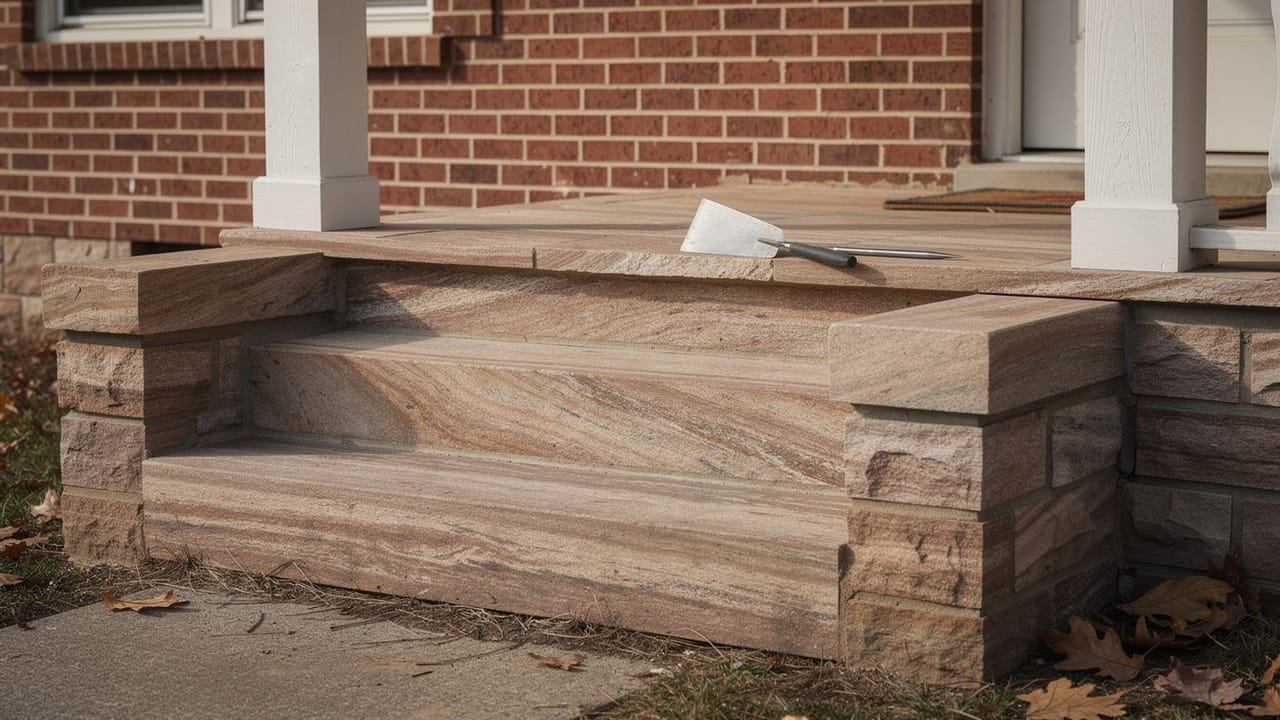
A fieldstone wall, a set of stone steps or stone porch piers is stonemason work. Each replacement piece has to be cut and dressed to fit the gap it fills, and the joints are finished by hand. Someone who only lays brick can fill a gap in a stone wall, but the patch will usually show.
Two related choices sit outside this one. Real stone and manufactured stone veneer go on differently, and our post on stone veneer versus real stone covers that. A wall that holds back soil is a question of design before it is a question of material, which our retaining wall page takes up.
- Brick veneer, brick chimneys, block walls: brick and block work
- Fieldstone walls, stone piers, stone steps and walks: stone work
- A house with both: a crew that works in both, or one of each
Where is Crab Orchard stone used in Middle Tennessee?
First in chimneys and foundations, later in landmark buildings, and then in ordinary houses. The Tennessee Encyclopedia’s entry on Crab Orchard stone, a history reference from the Tennessee Historical Society, describes it as a rare sandstone quarried from Crab Orchard Mountain on the Cumberland Plateau, mostly rose in color and streaked with shades of brown. Until the late 1800s it went mostly into chimneys and foundations in the area where it was quarried.
Nashville gave it a wider name. The encyclopedia says architect Henry Hibbs chose it as the main building material for Scarritt College in the mid-1920s, and that contractors across Middle Tennessee went on to use it for bungalows and other mid-twentieth-century houses. It is also in the newer Country Music Hall of Fame Museum downtown.
That history is why a stone chimney, porch or set of piers on an older house in the region can be Crab Orchard stone, and why repairing it is a stonemason’s job. A missing piece has to be matched in color and cut to the shape of the hole, and a brick mason’s line and level do not help much with that.
What to ask before a mason starts
The useful question is not the title on the truck but the work behind it. Ask a mason which of their recent jobs were brick and which were stone, and ask to see joints they finished in each. On brick, ask how they will match the existing courses and joint profile. On stone, ask how they will cut and fit the replacement pieces.
Ask about the license as well. Tennessee licenses contractors, and the state’s verify.tn.gov license lookup shows whether a person or company holds a license and what it covers.
When you are ready, describe the wall, steps or chimney to us and say what it is made of, whether brick, block, stone or a mix, and we will tell you which of our masons takes the job and send a written price.
Sources
- O*NET OnLine, Brickmasons and Blockmasons (47-2021.00), U.S. Department of Labor — What brick and block masons do, their tasks and reported job titles
- O*NET OnLine, Stonemasons (47-2022.00), U.S. Department of Labor — What stonemasons do, their tasks and reported job titles
- Tennessee Encyclopedia, Crab Orchard Stone (Tennessee Historical Society) — History of the stone and its use in Nashville and Middle Tennessee
- State of Tennessee, verify.tn.gov license lookup — Where to check a contractor’s Tennessee license
FAQ
Brick Mason or Stone Mason: Who Does What — questions
What does a stonemason do?
A stonemason builds and repairs structures made of stone, such as walls, piers, steps and walks. O*NET lists the tasks: setting alignment with a plumb bob and level, cutting and shaping stone to fit, setting it to a layout or pattern, and finishing the joints between stones with a trowel and a tuck pointer.
Is a mason a bricklayer?
Often, yes. O*NET lists Bricklayer, Brick Mason and plain Mason among the reported job titles for brickmasons and blockmasons. But Mason also appears among the stonemasons’ titles, so the word alone does not tell you whether someone mainly lays brick and block or works in stone. Ask which they do most.
What is the difference between a brick mason and a stone mason?
The material and the skill it takes. A brick mason lays brick and block, which come in standard sizes, keeping each course on a line and tooling the mortar joints. A stonemason cuts and shapes irregular stone to fit, sets it to a pattern and finishes each joint between stones by hand.
Does a brick mason also work with stone?
Some do, and the reverse happens too: O*NET’s stonemason profile includes laying brick for chimney shells. They are still separate occupations with different tasks. On a house with both brick and stone, ask which material a mason works in most, and look at finished joints in each before you hire.
What is Crab Orchard stone?
A rare sandstone quarried from Crab Orchard Mountain on the Cumberland Plateau, mostly rose with brown streaks, according to the Tennessee Encyclopedia. In Nashville it was the main material for Scarritt College in the mid-1920s and appears in the Country Music Hall of Fame Museum, and it was used in bungalows across Middle Tennessee.
Is a brick house considered masonry?
Yes. Brick laid and bound with mortar is masonry, and building or repairing walls that way is the core of the brickmason’s work as O*NET describes it. So repairs to the brick walls, steps or chimney of a brick house call for a brick mason, while any stone steps or trim call for stone work.