
· by Michael Blair, Nashville's Masonry
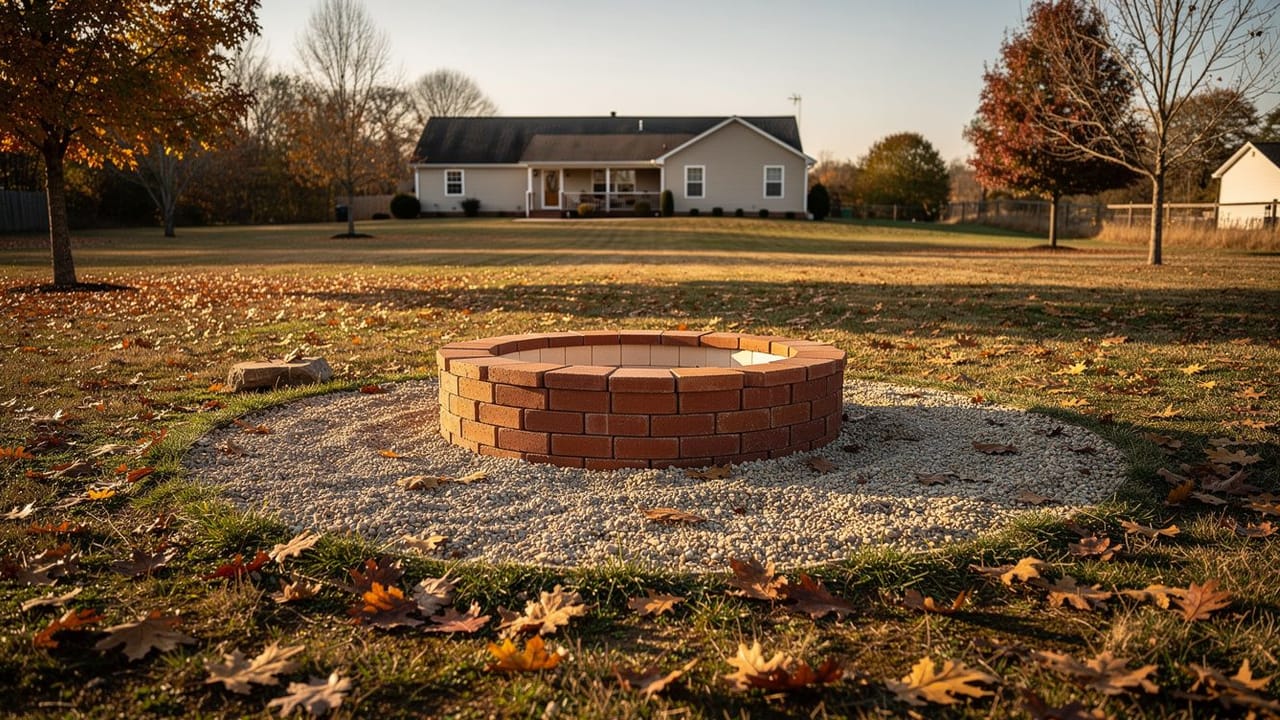
A brick fire pit looks like the simplest thing a mason builds: a ring of brick, a few courses high, with a fire in the middle. That is exactly why so many of them fail. Built like a garden wall, the inside face takes direct flame it was never made for, the mortar joints cook and crumble, rain fills the bowl and sits there through a winter of freezing nights, and within a few seasons the ring is cracked and loose. A pit that lasts is built in two layers, on a base that drains, in a spot the fire code allows. This is how we think through one, and it is the same thinking behind the fire pits on our fireplaces and fire pits page.
Two walls, not one
The ring that faces the fire and the ring that faces your guests do different jobs, so they should be different materials. The inside is lined with firebrick, a dense brick made to take repeated heating and cooling, laid with a refractory mortar in thin joints. The outside is ordinary face brick, chosen to match the house or the patio, laid in regular mortar where it never sees the flame. Face brick and standard mortar on the inside of the bowl are what turn a fire pit into a pile of spalled brick and sandy joints, the same failure we describe in why mortar fails before the brick does, only faster.
The refractory mortar has to be one made for outdoor use, and the label is the place to check. A common hardware-store choice, Rutland’s refractory cement, is rated to 2000 degrees Fahrenheit and made for setting firebrick in joints of a quarter inch or less, but the maker states it is for indoor use only and that it needs heat to cure. It belongs in a fireplace firebox, not in a pit that sits in the rain. Where the product a mason plans to use says indoor only, ask what they are using outside instead.
The base, the drainage and the size
Most of what goes wrong with a fire pit starts underneath it. Our clay soil holds water and moves as it wets and dries, so a ring set straight on the lawn or on a thin bed of sand settles unevenly and cracks. We dig out the soft topsoil and build on a compacted gravel base that sheds water away from the brick. The bowl itself needs a way to drain: gravel in the bottom and small openings at the base of the ring so rain does not pool inside, soak the brick, and freeze. Water held in masonry through a Middle Tennessee winter is what pops brick faces and breaks joints.
Size is a matter of the fire you actually build and the people around it. A bowl wide enough for split firewood laid flat, but not so wide that the fire sprawls, burns cleaner and is easier to tend. The wall height and the cap matter for seating: if the cap is meant to be sat on or to rest feet against, it should be at a comfortable height, with a solid stone or brick coping that sheds water off the top rather than into the joints. Chairs, not built-in benches, keep the flexibility to pull back when the fire is hot.
- Compacted gravel base, not bare soil or a sand bed
- Drainage at the bottom of the bowl and the ring
- Firebrick inside, face brick outside
- A sloped coping that sheds water off the top
Where it can sit, and which number applies
This is the part to get right before any brick is ordered, because the figures people quote are not all the same rule. The model International Fire Code, at section 307.4.2 of the 2021 IFC, says a recreational fire cannot be within 25 feet of a structure or combustible material. A different section of the same chapter, 307.4, covers open burning generally and sets 50 feet from a structure, with an exception of 15 feet for fires in approved containers. Those two sections are often blended together online, and they are not the same thing.
Metro Nashville changed the recreational fire number. Metro’s 2015 fire code amendment, BL2015-1145, replaced 307.4.2 and required recreational fires to be at least 50 feet from a structure or combustible material, double the model code. Metro has since moved to the 2024 International Fire Code with local amendments, listed in Metro Code Section 10.64, and we could not confirm whether the 50 foot figure carried forward. On a typical lot in Davidson County, the difference between 25 and 50 feet decides whether a pit fits at all, so call the Metro Fire Marshal’s Office before you settle on a spot. Outside Davidson County, ask the city or county fire department where you live.
Whether a built-in pit needs a building permit is also unsettled. Metro’s residential permit page lists fireplaces and accessory structures among the work that needs one, but it does not mention fire pits. We ask Metro Codes on each job rather than guess.
The burn season, and when a freestanding pit is wiser
Every fall the state burn permit season comes up, and it is easy to think it applies to a backyard pit. It mostly does not. The Tennessee Division of Forestry’s safe debris burning rules require a permit from October 15 through May 15 for burning leaf piles and woody debris, and they say restrictions do not prohibit campfires or outdoor grilling. A burn ban is different: it stops all open-air burning, campfires and grills included. So the permit does not cover your fire pit, and a ban shuts it down. A fire pit is also not a place to burn yard waste. The Nashville Fire Marshal’s FAQ says no burn permit is issued for brush or leaves in a yard; Metro’s yard waste collection and brush disposal are the route for those.
Some yards are better served by a steel pit you can buy and move. If the lot cannot give the clearance Metro asks for, if the patio layout may change in a few years, or if you rent, a permanent masonry ring is a lot of brick to commit to one spot. A built pit earns its cost when it has a clear site that meets the distance, a drained base, and a place in a patio or seating wall meant to last as long as the house. When we look at a fire pit job, we check the distance first, the ground second, and the brick last. If you want us to look at your yard, ask for a free estimate.
Sources
- International Fire Code 2021, Section 307 (UpCodes, Tennessee) — Recreational fires 25 feet from structures (307.4.2); open burning 50 feet, 15 feet for approved containers (307.4).
- Metro Nashville Ordinance BL2015-1145, fire code amendments — Metro amended 307.4.2 to require recreational fires 50 feet from a structure or combustible material.
- Nashville Fire Department, Code Editions — Metro enforces the 2024 International Fire Code with local amendments in Metro Code Section 10.64.
- Nashville Fire Department, Fire Marshal’s Office FAQ — No burn permit is issued for burning brush or leaves in a yard.
- Metro Codes, Residential Building Permits — Lists fireplaces and accessory structures as permitted work; does not mention fire pits.
- Tennessee Division of Forestry, Safe Debris Burning — Permit required October 15 to May 15 for debris burning; campfires not prohibited by restrictions; burn bans prohibit all open burning.
- Rutland Products, Refractory Cement — Rated to 2000 F for firebrick joints of 1/4 inch or less; requires heat to cure; labeled indoor use only.